WILDLIFE SANCTUARIES OF ASSAM
The wildlife sanctuaries in Assam are a heterogeneous mixture of a variety of landscapes, plants, birds and animals. The suitable climatic conditions, geographical location and vast forest reserves have made Assam a favorable destination for birds, animals and natural vegetation. Seeing this beautiful place will give you such inspiration and happiness and peace that it a place one must go.
Assam is home to several wildlife sanctuaries and national parks that are the breeding ground for some of the rarest global species. The many wildlife sanctuaries in Assam provide shelter to large number of wildlife right from the Golden Langur to the one-horned rhinoceros, as well as a large variety of flora especially the beautiful orchids. Below are listed some of the most beautiful and amazing wildlife sanctuaries and national reserves that one must visit if they are ever on a trip to the beautiful Assam in the north-east.
Assam is home to several wildlife sanctuaries and national parks that are the breeding ground for some of the rarest global species. The many wildlife sanctuaries in Assam provide shelter to large number of wildlife right from the Golden Langur to the one-horned rhinoceros, as well as a large variety of flora especially the beautiful orchids. Below are listed some of the most beautiful and amazing wildlife sanctuaries and national reserves that one must visit if they are ever on a trip to the beautiful Assam in the north-east.
POPULAR WILDLIFE SANCTUARIES AND NATIONAL PARKS
1. MANAS
NATIONAL PARK:

Located in the
foothills of the Assam Himalayan range, Manas is an amalgamation of being a
national park, a UNESCO world heritage site, an elephant reserve, and also a
tiger reserve. And it also has been recognized as an important biosphere reserve.
People mainly go to
this place for its tiger reserve and the sporting opportunity of river rafting.
This river known as the Manas River or Beki River is a continuous flow from
beyond the Bhutan border. The best time to have this fun is during the winter
time from the first week of October [winter time] to the last week of April
[spring time].

FAUNA OF MANAS:
We can find a wide range of rare endangered
animals dominating the landscape. Spread over an area of 950 sq km the park
host amazing animals like: Assam roofed
turtle, hispid hare, golden Langur and pygmy hog which are not only endangered
but are considered ecologically important.
Also other beautiful
animals that we can spot are the:
Asian elephant
Indian rhinoceros
Asian water buffalo
Tigers
Leopard
Asian golden cat
Capped Langur
Assamese macaques
Slow Loris

Hoolock gibbons
Sloth bears
Barking deer
Black Panther
Sambar deer
Also the flora is as diverse as it gets. The
vegetation of this place is mostly covered with mixed deciduous forest with small grass strewn all over the place on which the deers of the reserve thrive. It is for the fact that it is covered
with such abundance of vegetation that all the animals thrive beautifully in
this haven of a reserve. Manas national
park is also one of the most bio-diverse regions of the planet.

THINGS TO DO:
The most popular things to do while in Manas wildlife sanctuary are:
1.Bird Watching
2.Jeep Safaris
3.Elephant Safari
2. CHAKRASHILA WILDLIFE SANCTUARY
The
Chakrashila Wildlife Sanctuary, is one
of the most popular wildlife sanctuaries in Assam. Situated in the Kokrajhar
and Dhubri districts of Assam, this wildlife sanctuary spreads over an area of
45.568 km on the Chakrashila Hills. The sanctuary was declared as a reserve
forest in 1966 and in 1994 it was recognized by the state government as a
wildlife sanctuary. A local group of environment activists known
as Nature’s Beckon played a crucial role for the region to be
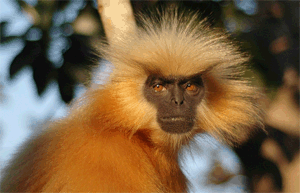
recognized as a sanctuary. It is famous for its golden langur and is the second protected habitat for golden langurs in India.
FLORA AND FAUNA IN CHAKRASHILA

The
sanctuary is dominantly a hilly tract that extends from north to south. There
are two lakes in the sanctuary - Dheer Lake and Diplai Lake. The
lakes are bio-diversity hotspots and critical to maintain the ecosystem of the
sanctuary. The forest was declared a sanctuary to secure the endangered species
and to protect their natural habitat. There are 30 species of mammals that have
been spotted in the sanctuary. Encompassing the Beel and Diplai Beel Lakes this
wildlife sanctuary offers a host of wildlife attractions like:
Golden Langur
Indian Flying Fox
Indian False Vampire
Indian Pipistrelle
Rhesus
Macaque
Short-tailed
Mole
Chinese
Pangolin
Short
Nosed Fruit Bat
Asiatic
Jackal
Bengal
Fox
Horn-bill
Also the sanctuary happens to be the second
protected home of the endangered Golden
Langur. A local group of
environment activists known as Nature’s Beckon played a crucial role
for the region to be recognized as a sanctuary.
More
than 250 species of birds including many rare and endangered birds can be
spotted in the sanctuary.
Open
Billed Stork
Greater
Adjutant Stork
Little
Egret
Shrikes
Pond
Heron
Drongoes
Darter
Hornbills, are the most exotic among the birds.
There
are 23 species of amphibians and reptiles found in the sanctuary which include
turtles, frogs, lizards and snakes. Over 40 species of butterflies and over 60
species of insects can be found in the sanctuary. The sanctuary provides
opportunities for trekking, bird watching and wildlife photography. The forests
in the sanctuary are of dense semi-evergreen and moist deciduous type, with
patches of grasslands and scattered bushes, and several water sources. The
climate is temperate, with dry winters and hot summers followed by heavy rains.

3. KAZIRANGA
NATIONAL PARK
It is situated on the banks of the Brahmaputra
River. This wildlife sanctuary in Assam spreads over 800 sq km of vast green vegetation. The backdrop of Kaziranga
National Park Assam includes dry deciduous forests, rocky landscapes and
tall thickets. The vast tracts of grasslands make bird and wild life watching
extremely pleasurable. The major attractions in this sanctuary apart from the
abounding natural beauty are the rhinos. The entire park can be visited in a
jeep and you can actually see the animals from just a few centimeters away.
Along with the iconic Greater one-horned rhinoceros, the park is
the breeding ground of elephants, wild water buffalo, and swamp deer. Over the
time, the tiger population has also increased in Kaziranga, and that's the
reason why Kaziranga was declared as Tiger Reserve in 2006. Also, the park is
recognized as an Important Bird Area by Birdlife International for the
conservation of avifaunal species.
FLORA:
The vast expanse of tall elephant grass, marshland, and dense
tropical moist broad-leaf forests undoubtedly makes the park look beautiful but
it's the presence of Brahmaputra River, which makes it look enigmatic.
Due to
the difference in altitude between the eastern and western areas of the park,
here one can see mainly four types of vegetation’ like alluvial inundated
grasslands, alluvial savanna woodlands, tropical moist mixed deciduous forests,
and tropical semi-evergreen forests. Kumbhi, Indian gooseberry, the cotton
tree, and elephant Apple are among the famous trees that can be seen in the
park. Also, a good variety of aquatic flora can be seen in lakes, ponds, and
along the river shores.
FAUNA:
The
forest region of Kaziranga Park is home to world's largest population of Indian
Rhinoceros. Other animals that can be seen in the elephant grass, marshland and
dense tropical moist broad leaf forests of Kaziranga are:

Hoolock Gibbon
Tiger
Leopard Indian Elephant
Sloth
Bear
Wild
water buffalo
Swamp
deer, etc.
With
increase in tiger population every year, the government authorities declared
Kaziranga as a Tiger Reserve in the year 2006. Also here one can find good
number of migratory bird species from Central Asia.
BEST TIME TO VISIT:
Kaziranga
Park remains closed from 01 May till 31 Oct every year for the visitors.
Therefore November to April is the best time to visit Kaziranga National Park.
Summer
(April to May): During this time of the year, the climate remains dry and
windy; one can find animals around the water bodies.
Monsoon
(June to September): From
June till September, the region receives heavy rain, approximately 2,220
millimeters (87 in); thus the climate remains hot and humid. The park remains
closed from May to October due to warnings of Brahmaputra river floods.
Winter
(November to February): Perhaps the best
time to visit the Kaziranga National Park as the climate is mild and dry.
Chances of spotting rhinos are more in winter as the grass burn off and the
background becomes clearer.
SAFARI:
To
promote wildlife tourism in Assam, Kaziranga Park authorities organizes a jeep
and elephant safari tour.
SAFARI GATES/ZONES:
Sprawling
over an area of 430 sq km, the park alias the hotspot of diversity is split
into four areas; each has its own distinguish feature regarding grasslands, the
density of mammals & bird, land topography, terrains. Below are some points
of the pre-defined tourist circuits where the jeep safari takes place:
- Mihimukh
in Central Range at Kohora
- Bagori
in Western Range at Bagori
- Agaratoli
in Eastern Range at Agaratoli
- Ghorakati
in Burapahar Range at Ghorakhati
 |
| LEOPARDS RESTING. |
To enjoy
the best of the park, it would be good to take a jeep or elephant but what
apart from these options? Fortunately around Kaziranga, one can find an ample
number of nature getaways options like wildlife sanctuaries, parks for bird
watching and hill stations.
4.THE HOOLLONGAPAR GIBBON SANCTUARY
 |
| ENTRANCE TO HOOLLONGPAR GIBBON WILDLIFE SANCTUARY |
It was constituted in 1997. This wildlife
sanctuary is in an isolated region in Assam and is sure to give you goose
bumps. Surrounded by tea gardens and long stretches of grasslands this wildlife
sanctuary in Assam is reputed throughout the country for its rich biodiversity.
If you are a true animal lover then this is just the right place for you. The
Hoollongapar Gibbon Sanctuary is home to the only gibbons in India; the hoolock
gibbons, and Bengal Slow Loris, Northeastern India's only nocturnal monkey.
FAUNA:

HOOLOCK GIBBON

The sanctuary has a very rich
biodiversity and is home to the only apes in India, the western hoolock gibbon (Hoolock hoolock), as
well as the only nocturnal primate found in the northeast Indian states,
the Bengal slow loris (Nycticebus
bengalensis).
Other primates include:
 The stump-tailed macaque (Macaca arctoides)
Northern pig-tailed macaque (Macaca
leonina)
Eastern Assamese
macaque (Macaca assamensis assamensis)
Rhesus macaque (Macaca
mulatta)
Capped Langur
(Trachypithecus pileatus).
Also found at the sanctuary are:
Indian elephant
Tigers (Panthera
Tigris)
Leopards (Panthera pardus)
Jungle cats (Felis chaus)
Wild boar (Sus scrofa)
FLORA:
 |
| Add caption |
The sanctuary has a rich diversity of flora at )
Nahar (Mesua ferrea)
dominates the middle canopy with its spreading crown,
casting fairly heavy shade over a wide area. Other species that make up the
middle canopy include:
Bandordima (Dysoxylum procerum)
Dhuna (Conarium resiniferum)
Bhomora (Terminalia belerica)
Ful Gomari (Gmelina sp.)
Bonbogri (Pterospermum lanceafolium)
Morhal(Vatica lanceafolia)
Selleng (Sapium baccatum)
Sassi (Aqualari agolacha)
Otenga (Dillenia indica)
A variety of evergreen shrubs and
herbs make up the lower canopy and ground layers. The most common of these are:
 Dolu bamboo (Teinosstachyum dullooa)
Bojal bamboo (Pseudostachyum polymorphum)
Jengu (Calamus erectus)
Jati bet (Calamus spp.)
Houka bet (Calamus spp.)
Tora (Alpine allughas)
Kaupat (Phrynium imbricatum)
Sorat (Laported cremulata)
POPULAR THINGS TO DO & SEE IN AND AROUND:
The sanctuary
witnesses many tourists visiting the place almost all round the year and a
number of bungalows have been constructed so that the tourists can reside here
comfortably. You will get to see many tea gardens surrounding the sanctuary
which act as a geographic barrier for the animals. There also many ferns,
orchids, bamboo and canes that enrich the reserve. The Hoollongapar Gibbon
Wildlife Sanctuary is an absolute treat for the nature lovers out there.
GETTING THERE:
The nearest
airport to the sanctuary is the Jorhat airport and the closest railway junction
is the Mariani railway station.
5. DIBRU-SAIKHOWA
NATIONAL PARK

The sprawling Dibru Saikhowa National Park,
spread over an area of 650sq km, is located close to the eastern border of Assam, straddling both
the districts of Dibrugarh and Tinsukia.
It is popular all over the country for its
collection of wild horses known as Feral Horses. This sanctuary is home to some
of the rarest white winged species. The sanctuary houses a number of unique and
beautiful migratory birds. Comprising
tropical moist deciduous forests,
tropical semi-green forests, Salix swamp forests, moist evergreen forests,
grasslands and canebrakes, Dibru Saikhowa National Park is one of the 19
biodiversity hotspots in the world. The region originally comprised a tropical
rain-forest but after the disastrous earthquake of 1950, it underwent major
geomorphologic changes and the rain-forest eventually gave way to deciduous
forests.
The park is bounded by the Brahmaputra River,
Lohit River and Arunachal Hills in the north and Dibru River, Debang River,
Dibru and Patkai hills in the south, making for beautiful, verdant
surroundings. The climate is tropical
monsoon – where the summers are usually hot, humid and wet with a maximum
temperature of around 35°C. The
winters are cold and dry, with temperatures between 7°C to 18°C.
FLORA AND FAUNA:

The Dibru Saikhowa National
Park, created especially for the conservation of the rare and endangered
white-winged wood duck, now houses numerous species of endangered mammals,
reptiles and birds. Till date 36 species
of mammals, 502 species of birds, 104 species of fish, 43 species of reptiles,
105 species of butterflies and 680 species of plants have been recorded
here. Moreover, 25 per cent of India’s threatened bird species have been found
in the Dibru Saikhowa National Park. The park is also home to nearly 50 feral
horses, which can be spotted in the northern part of the park at the Churkey Chapori
area. These horses are believed to have descended from the animals that escaped
from the army camps during World War II. River dolphins are also often seen in
the sanctuary’s water.
Wildlife frequently spotted
here includes:
Sambar
Sloth bear
Dhole
Small Indian civet
 Malayan giant squirrels
Chinese pangolin
Capped Langur
Indian elephant
Indian elephant
wild boar
Hoolock gibbon
hog deer
barking deer.
If your luck holds, you might even spot one of the big cats – a royal Bengal tiger or a leopard – or the relatively rare Gangetic River Dolphin gamboling in the water.
 The park is mainly consists of
semi wet evergreen forests, tropical moist deciduous forest, bamboo, cane
brakes and grasslands. Dibru-Saikhowa is an area of grassland and swamp forest
sandwiched between the Brahmaputra and Dibru rivers in the east of Assam.
Contained between these rivers, the park is a 340sq km reserve, which was set up with a view to protecting the grassland
and swamp habitat on the flood plains of the Brahmaputra River.It is located at about 13 km north of
Tinsukia town and about 515 km from Guwahati and is bounded by the
Brahmaputra River and Arunachal hills in the north and Dibru River and Patkai
hills on the south.
The park is mainly consists of
semi wet evergreen forests, tropical moist deciduous forest, bamboo, cane
brakes and grasslands. Dibru-Saikhowa is an area of grassland and swamp forest
sandwiched between the Brahmaputra and Dibru rivers in the east of Assam.
Contained between these rivers, the park is a 340sq km reserve, which was set up with a view to protecting the grassland
and swamp habitat on the flood plains of the Brahmaputra River.It is located at about 13 km north of
Tinsukia town and about 515 km from Guwahati and is bounded by the
Brahmaputra River and Arunachal hills in the north and Dibru River and Patkai
hills on the south.
It is the largest Salix swamp forest in north east India. Dibru Saikhowa has tropical monsoon climate with a hot and wet summer and cool and usually dry winter.
Dibru-Saikhowa National Park is
divided into nine distinct zones one of which is a wetland while dense forests
occupy the remaining portions. The sparkling sylvan wetlands paint a picture of
rare beauty as the gleam like a mirage of quicksilver under the playful saffron
sunbeams.
 The climate is tropical. Summers are
hot and wet whereas winters are cold and dry. The annual temperature ranges
from a minimum of 7°C and to a maximum of 34°C.
The climate is tropical. Summers are
hot and wet whereas winters are cold and dry. The annual temperature ranges
from a minimum of 7°C and to a maximum of 34°C.DOMINANT FLORA:
Tetrasperma
Dillenia indica
Bombax ceiba
Lagerstroemia parviflora
Terminalia myriocarpa
Mesua ferrea
Dalbergia sissoo
Dalbergia sissoo
Dibru-Saikhowa,
Arundo donax,
 Imperata cylindrica
Phragmaties karka
Erianthus ravanea etc.
THINGS
TO DO:
Tip: Hiring
a local guide is highly recommended. They are a mine of information on the park
and have adequate knowledge about the concentration of wildlife, making for a
rewarding trip.
Boat
Safari:
There are no elephant or
jeep safaris in Dibru Saikhowa National Park and visitors have to hire a local
boat to explore the park. You are likely to spot water buffalos basking in the sun by the muddy banks, turtles
swimming past and groups of storks fishing in the water.
Trekking:
Another rewarding way of
exploring this national park is by way of trekking cum hiking . The jungle is quiet, far
away from the cacophony of the city, and the stillness is only broken by the
rustle of dry leaves beneath your feet or the chorus of birdcalls. Your guide
will lead you down the forest trails.
It is also possible to
explore the two villages inside the park, Dhadia and Laika and
see how the locals live. Or you could head to Maguri Beel, adjacent
to the park, where a variety of birds can be spotted.
FAST
FACTS
When to
go: November–April
STD code: 0374
State: Assam
Location: In
Dibrugarh and Tinsukia districts, on the southern bank of River Brahmaputra
Distance: 443km
NE of Guwahati, 90 km NE of Dibrugarh city
Route
from Dibrugarh: NH37 via Lahowal, Tinsukia, Makum, Doom Dooma and Rupai Siding.
6. DEEPOR BEEL BIRD SANCTUARY

It is a proposed sanctuary in Assam that is
supposed to be situated amidst a zone of idyllic bliss with its lush greenery
sprinkled with sparkling water bodies. The sanctuary's premises exude an aura
of tranquility and the melodious twitters of birds are a welcome break that
occasionally disturbs the quietude.
As the name signifies Deepor Beel Bird Sanctuary, Guwahati is being constructed to
shelter abundant species of birds dappled in vibrant hues. The Department of
Forests, Assam has listed over 120
species of birds to be housed in the sanctuary. They include numerous kingfishers, fishing eagles,
adjutant storks and a plethora of ducks.
FLORA AND THE NATURAL HABITAT:
The hydrophytic vegetation of the Beel
has been classified, based on ecological adaptation, into the following
categories with their floristic elements.
Aquatic vegetation like:

aquatic grasses,
waterlilies and other submerged, emergent
and floating vegetation are found during the summer season.
In the dry areas, during winter,
aquatic and semi-aquatic vegetation are seen.In deep open water
area, marshlands, mud flat, emergent
vegetation, water hyacinth patches, net-grass land patches are reported.
Migratory water-fowl, residential
water-fowl and terrestrial avifauna are common in paddy field areas, dry grassland areas and scattered forest
areas.
A total of 18 genera
of phytoplankton are reported from the core area of the Beel ecosystem out
of which species of Oscilatoria and Microcystis are
dominant.
List of aquatic plants identified in the Beel
are:

Ottelia alismoides
Ipomoea reptans,
Azolla pinnata,
Spirodela polyrhiza,
Eleocharis plantaginea
Nymphaea rubra
Euryale ferox, a giant water lily with edible seeds, is leased to earn
revenue for the
government.
Other lake shore vegetation includes:
·
Eupatorium adoratum,
·
Phragmites karka,
·
Accium
basilium,
·
Imperata arundinacea.
Dominant tree species in the
nearby Deciduous forests in
the Beel basin are species of Tectona grandis or common teak, Ficus benghalensis, Shorea robusta and Bombax malabaricum. In
the surrounding forest area, aquarium plants, medicinal plant and orchids of commercial value are reported.
AVIFAUNA OF THE BIRD SANCTUARY:

The sanctuary is a
great food source and a great breeding ground for a large variety of
residential water birds as well as a number of migratory waterfowls,
amphibians, reptiles, insects, micro and macrophytes, terrestrial weeds. The
Department of Forests, Assam has listed 170 species of Birds - 2 critically
endangered, 1 endangered, 5 vulnerable and 4 near threatened such Spot billed
pelican, Lesser adjutant stork, Greater adjutant stork, Black necked stork and
Large whistling teal.
The most notable bird
species found in the sanctuary are:
Kingfishers
Fishing
eagles
A plethora of ducks
 Greater
Adjutant Stork
Greater
Adjutant Stork
Whistling
Teal
Open
Billed Stork
Shoveler
Pintail
Garganey
Pheasant tail jacanas
etc.
Occasional it is visited by the herd Elephant
from the adjacent Rani–Garbhanga landscape. Some of the largest congregations
of aquatic birds in Assam can be seen here, particularly in winter.
AQUA FAUNA:
Surveys have
revealed 20 amphibians, 12 lizards, 18 snakes and 6 turtle and tortoise species
in the Beel. Over 50 commercially viable species of fish, belonging to 19
families have been identified, which supplies stock to other nearby wetlands
and rivers. The Beel provides food, acts as a spawning and nursery water body;
some of the species breed within the Beel.
BEST TIME TO VISIT:
The best time to visit the sanctuary is during the period of October to March. Visitors can have spectacular view of different species of flora and fauna in the sanctuary.
The Sanctuary is nearly 20 km. away from Guwahati city. One can visit the place from within the city or on the way from the airport.
7. POBITORA
WILDLIFE SANCTUARY:
 |
Pobitora Wildlife Sanctuary, situated in the flood plains of River Brahmaputra in the district of Morigaon and about 45 km from Guwahati, the capital of Assam, India. Pobitora originally was a grazing reserve for cattle of erstwhile Nagaon district, came into limelight during the year 1961-62 for sighting of One Horned Rhino (Rhinoceros unicornis). During that time a few rhinos strayed out of Lawkhowa and Orang Wild Life Sanctuaries and gradually became resident. Two such grazing reserves comprising 38.83 square kilometers was declared as reserve forests in 1971. In 1987, Pobitora was declared a wildlife sanctuary covering an area of 16 square kilometers. Presently the sanctuary is surrounded by 20 villages, the farmlands of which are frequented by rhinos. Pobitora has exceeded its rhino-bearing capacity and is overpopulated. Thus Pobitora Wildlife Sanctuary harbors world's highest density of rhinoceros. In winter, Pobitora becomes a birder’s heaven, with thousands of waterfowl thronging the wetlands. Pobitora can be divided into three distinct categories: forest, grassland and water bodies or beels. Only about 13% of the total area is under tree cover, consisting of Albizzia procera, Bombax ceiba, Lagerstromia flosreginae and Barringtonia acutangula. About 72%of Pobitora consists of wet savannah of Arundo donax, Erianthus ravennae, Phragmites karka, Imperata cylindrica, and Saccharum. The remaining area is covered by water bodies or beels.
BIODIVERSITY:

Pobitora is mainly famous for its
great Indian One-horned rhinoceros.
Besides rhinoceros, the other animals are leopard, wild boar, Barking deer,
wild buffalo etc. Assam’s Pobitora Wildlife Sanctuary is also home to more than
2000 migratory birds and various reptiles. It is also an Important Bird Area.
WILDLIFE AT POBITORA SANCTUARY:
The Pobitora Wildlife Sanctuary is famous for the one-horned
rhinoceros. Apart from this, the other animals found here are wild boars,
leopard, barking deer, wild buffalo, etc. This wildlife sanctuary is also a
significant bird area as it houses 2000 migratory birds and reptiles. In the
last six years, there has been an increase in the number of rhinoceros which
has gone up to 93. These 93 rhinoceros are surviving on the 16 sq km area of
the park which has led to overpopulation and the exploitation of the rhino
bearing capacity of the sanctuary. This has resulted in the animals moving out
of the park in search of food.
BEST TIME TO VISIT THE WILDLIFE SANCTUARY:

The
best time to visit Pobitora Wildlife Sanctuary is from November to February as
the climate around that time is pleasant during the day and chilly at night.
One needs to carry along adequate amounts of woolens during the months of
December-January due to extreme cold. Monsoon period should be strictly avoided
as the region is prone to flash floods and the conditions of the roads make
travelling almost impossible.
HOW TO REACH POBITORA WILDLIFE SANCTUARY:
· Air: Flights are available for Guwahati from all major
domestic airports in India. From there, you can hire a cab till Pobitora
Wildlife Sanctuary.
· Rail: The nearest rail-head is at Jagiroad which is well
connected to Guwahati. From Jagiroad, you can take public buses or a cab.
· Road: From Guwahati, Pobitora is a 2 hours ride via a
narrow road. If coming from Kaziranga on NH 37 take the route for Mayang at
Jagiroad. Buses are available from Adabari Bus Station in Guwahati till
Chamata. From Chamata catch a public bus for Kolangpur and take an auto
rickshaw to the Sanctuary. Alternatively, you can take a bus from Guwahati till
Morigaon and a bus from Morigaon till the Sanctuary.
Compiled and written by
Naomi Barua.
Ph -9864144470 and 7002605992
Google page - https://g.page/r/CWNLKramP2ucEBE

Comments
Post a Comment